Cloud and AI Cost Management
A workbook for everyone who truly wants to take control of cloud and AI costs.
This guide shows how cloud and AI costs can be
- cleanly modeled
- consistently analyzed
- and managed operationally
so they become comparable, explainable, and predictable.
Power BI, FinOps, and FOCUS together form the methodological foundation of the book.
For organizations of all sizes – from single-cloud to multi-cloud.
Available as an eBook and print edition.
Includes access to 46 KPI fact sheets.
From € 9,99
Why hardly anyone really has cloud and AI costs under control today
Cloud and AI costs don’t fail because of a lack of tools.
They fail because of a lack of control.
In most companies, at least one of the following is true – and often all of them:
- Cloud costs are visible but cannot be clearly allocated
- KPIs exist, but are not consistently defined
- Reporting shows numbers, but no decision-making logic
- Finance, engineering, and management teams operate under different assumptions
- AI costs arise suddenly and unexpectedly
Result:
Costs are explained after they have been incurred – not managed
The real problem runs deeper
FinOps is often reduced to processes, meetings, or tools.
Power BI is used as a reporting tool.
AI costs are “factored in” somewhere.
What is almost always missing is a comprehensive management approach:
- from raw data
- through clean data models
- to clear KPIs
- and routine operational processes
Without this foundation, FinOps remains theoretical
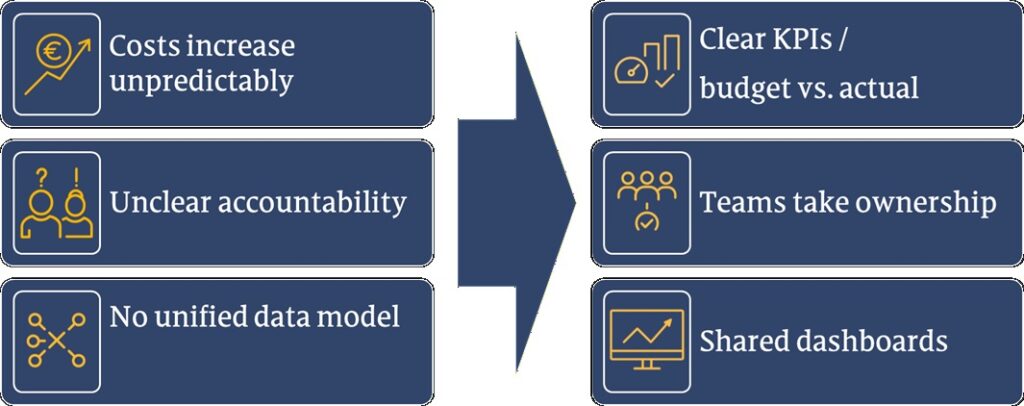
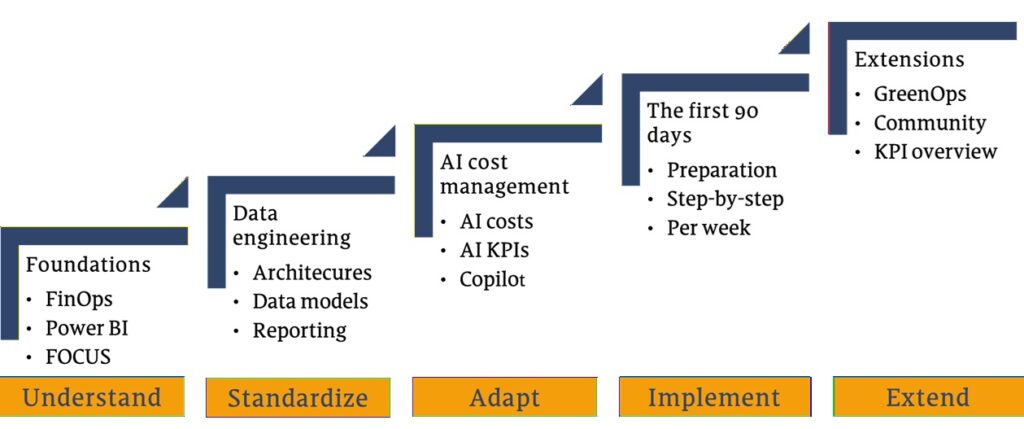
This book brings together elements that are often treated separately in practice:
- FinOps as a governance and accountability model
- Data engineering as a technical foundation
- Power BI as an operational governance platform
- AI costs as an integral component – not as a special case
Not abstract. Not tool-driven.
But actionable, using real cloud and AI data.
What sets this book apart
This book brings together elements that are often treated separately in practice:
- Cloud and AI costs in a single model
- FOCUS as a consistent data standard, explained in practical terms
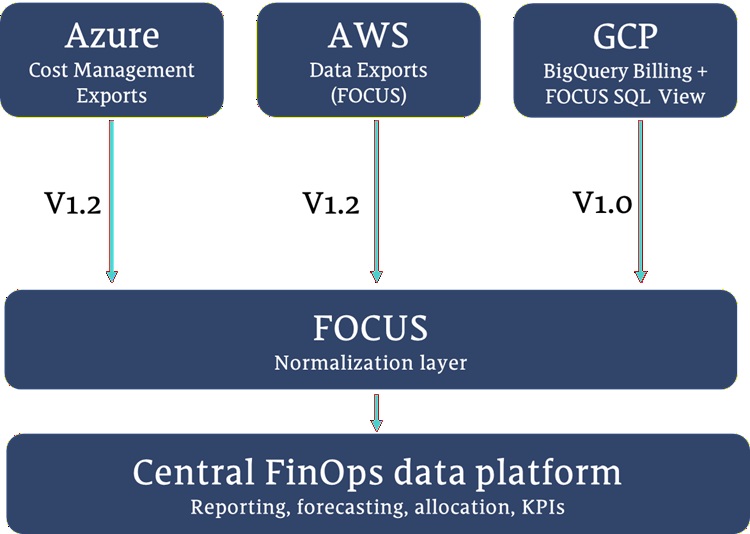
- End-to-end view: data pipeline → model → KPI → control
- Specific architectural options with decision-making guidance
- A 90-day implementation program with step-by-step instructions
- KPI framework with 46 KPI profiles as working materials
- Clear views for engineering, finance, and management
- Forecasting & optimization for token, GPU, and agent costs
- GreenOps integrated – costs and emissions
- Copilot-compatible data models for modern BI use
The goal is not to see cloud costs.
The goal is to make them manageable.
What you can put into practice after reading this
This book provides a concrete approach for systematically and accurately tracking cloud and AI costs and making them manageable during day-to-day operations.
1) Prepare reliable cloud and AI cost data
- Structured import of cost and usage data from Azure, AWS, and GCP
- Apply FOCUS as a uniform data format and interpret it correctly
- Identify and avoid typical data issues (duplicates, schema changes, reprocessing)
2) Build controllable data models
- Clearly separate raw data, enriched data, and reporting views
- Model costs so that they remain stable, scalable, and traceable
- Create semantic models suitable for Power BI, KPIs, and Copilot
3) Allocate and compare costs effectively
- Allocate costs to teams, products, workloads, or business units
- Establish uniform logic for single-cloud and multi-cloud scenarios
- Ensure comparability across time, regions, and cloud providers
4) Define KPIs, forecasts, and early warning signals
- Build a consistent KPI system instead of isolated metrics
- Forecast cost trends and identify deviations early
- Derive budgets, alerts, and thresholds in a meaningful way
5) Make AI costs manageable
- Integrate token, GPU, and workflow costs into a common cost model
- Derive AI-specific KPIs such as cost per request, feature, or version
- Assess the impact of model, prompt, or architecture changes
6) Establish governance and standard operating procedures
- Clearly define responsibilities and provide technical support
- Separate reporting views for engineering, finance, and management
- Treat FinOps not as a project, but as an ongoing management process
From Concept to Implementation in the Company
The book provides the methodology, structure, and decision-making framework needed to bring cloud and AI costs under control.
In many companies, this raises the same question: How do we implement this effectively, efficiently, and with clear lines of responsibility?
This is exactly where I come in as a pragmatic implementer.
Implementing the 90-day approach within the company
The 90-day approach described in the book can also be implemented directly within the company.
In doing so, I guide teams through three phases in a structured manner:
- Ensuring Transparency
Building the database, aligning with FOCUS, establishing the first reliable KPIs - Establishing Accountability
Allocating costs, clarifying roles, creating reporting views for different target groups - Embedding Control in Day-to-Day Operations
Establishing forecasts, budgets, early warning systems, and governance on a sustainable basis
The focus is on practical implementation using your own cloud and AI data, not on theoretical scenarios.
What the collaboration typically looks like
Our collaboration is structured in a modular way and tailored to your level of maturity and objectives:
- Review of existing data models and reports
- Joint development of a controllable cost model
- Consulting for data, FinOps, and platform teams
- Workshops on implementing or further developing routine FinOps operations
Always with the goal of measurably improving decision-making capabilities and controllability.

I’d be happy to discuss with you whether and how the approach described in the book can be applied to your cloud and AI environment.
No preparation, no sales pitch – just clear and practical advice.
Contact
Krenn GmbH
Toisenweg 13
4040 Linz
Österreich
Tel: +43 650 8112707
Mail: m.krenn@optimizeyour.cloud